

Introduction
Autism Spectrum Disorder (ASD) presents a diverse array of symptoms that can profoundly impact a child's social interactions, communication abilities, and behaviors. Early recognition of these symptoms is crucial, as timely interventions can significantly enhance developmental outcomes. This article delves into the various manifestations of ASD, highlighting the importance of early detection and intervention.
From understanding the social and communication challenges that children with ASD face to recognizing the significance of restricted or repetitive behaviors, the discussion explores innovative methods for early diagnosis and the vital role of supportive interventions. Empowering parents with knowledge and resources, this article aims to foster a better understanding of ASD and the essential steps needed to support children's well-being and development.
Understanding the Symptoms of ASD
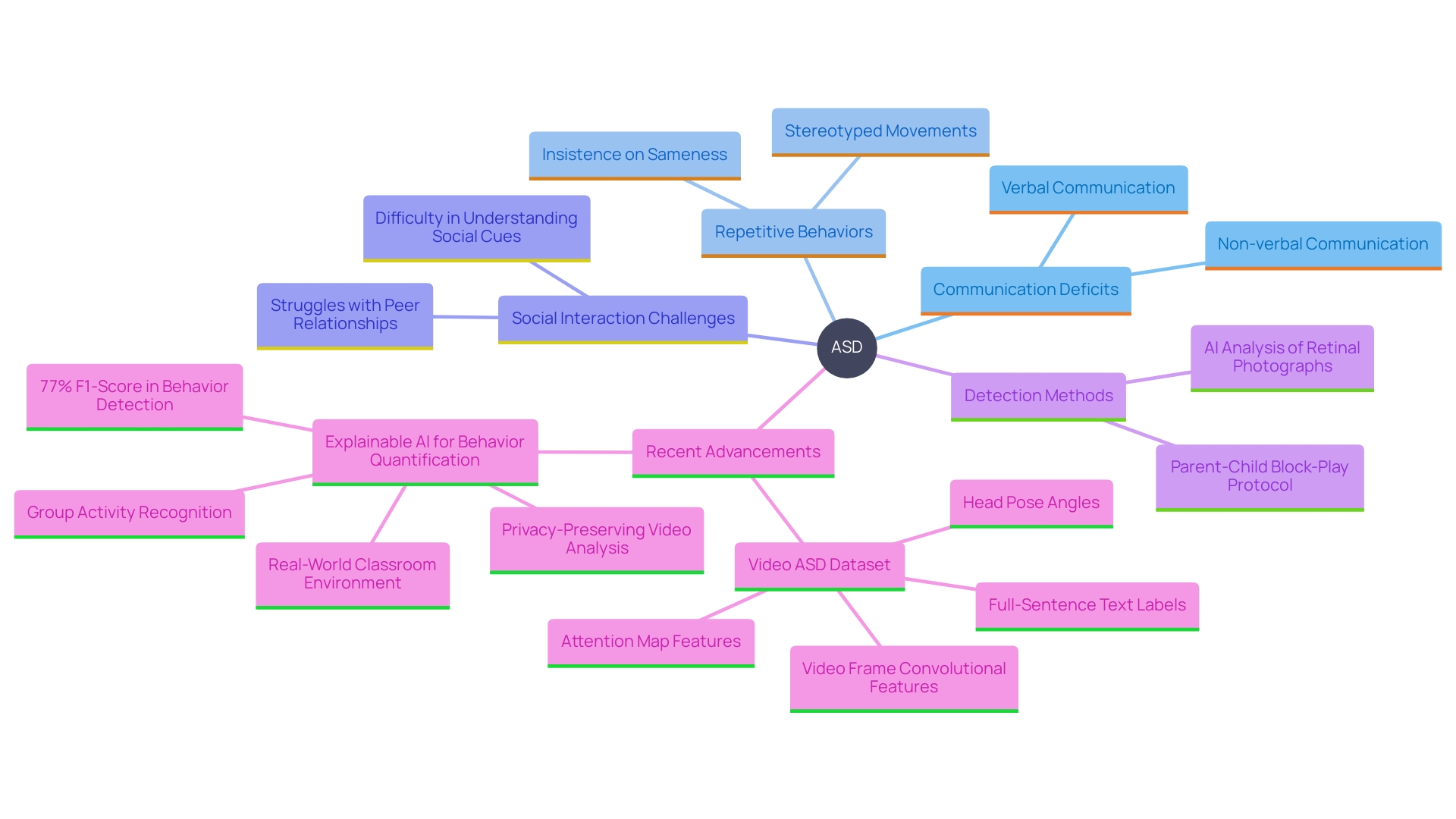
Autism Spectrum Disorder (ASD) encompasses a range of symptoms and behaviors, impacting individuals differently. Prompt identification of these symptoms can significantly impact a young person's development, leading to timely interventions. Symptoms may manifest in different ways, influencing interactions, communication, and behaviors. For example, individuals with ASD might find it challenging to comprehend interpersonal signals or sustain eye contact, and they may display repetitive actions or strong passions for particular subjects.
Recent advancements in initial detection methods emphasize the significance of prompt identification. A study introduced a novel approach combining a parent-child block-play protocol with an attention-enhanced deep learning framework. 'Observing parent-offspring interactions during block play provides insights into a young person's social and cognitive development, while the deep learning model analyzes these interactions to detect patterns indicative of ASD.'. This integrated method promises more effective initial ASD detection compared to traditional screening techniques.
Additionally, new technologies such as AI analysis of children's retinal photographs have shown potential in testing for autism and possibly assessing its severity. These creative methods highlight the essential function of prompt action, which has been shown to enhance interpersonal communication and other fundamental difficulties related to autism.
Dr. Friedman emphasizes that ASD involves deficits in communication and interaction, as well as restricted and repetitive behaviors. Understanding how these issues manifest across different settings is vital, alongside assessing co-occurring conditions like anxiety or ADHD. As Dr. Olena Iniutina observes, prompt assistance provides youngsters with autism with vital abilities that greatly improve their quality of life and community adjustment.
In summary, recognizing the diverse symptoms of ASD early can lead to timely, effective interventions that support improved developmental outcomes for youth with autism.
Social Communication and Interaction Symptoms
Children with Autism Spectrum Disorder (ASD) often face considerable difficulties in communication and interaction. They may find it difficult to engage in typical back-and-forth conversations, exhibit limited interest in sharing experiences, and struggle to understand non-verbal cues such as facial expressions and gestures. These difficulties can lead to feelings of isolation for both the young person and their family.
Timely action is crucial in addressing these core social difficulties. For instance, an intensive behavioral intervention developed in the United States has shown promising results by enhancing communication skills in young individuals with autism through playful interactions. Since its introduction, over a hundred youngsters under the age of three have benefited, illustrating the importance of timely support.
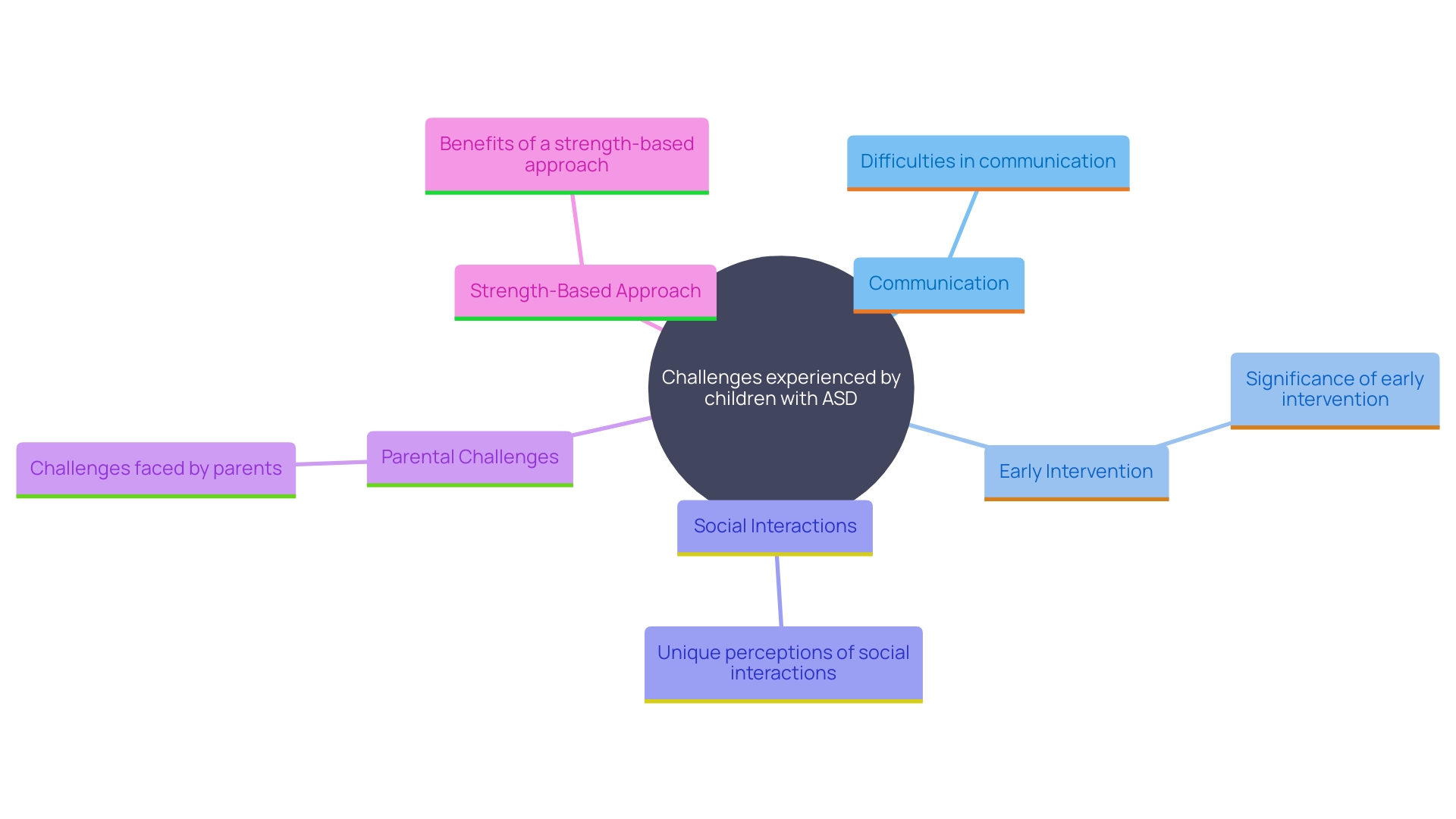
Research also highlights the unique ways autistic youngsters perceive interpersonal interactions. A study utilizing eye-tracking technology demonstrated that usually developing youngsters concentrate on social components in a scene, whereas autistic individuals do not, highlighting the necessity for customized approaches.
Additionally, parents, particularly those who are also on the spectrum, frequently encounter extra difficulties in obtaining the appropriate assistance for their kids. For many families, the broader system presents obstacles, rather than individual professionals. A strength-based approach, rather than a deficit-based one, can help in understanding and addressing these challenges effectively.
It is essential for practitioners to be equipped with the knowledge and skills to provide early, developmentally appropriate, and family-empowering interventions. This approach not only supports the young person's development but also alleviates some of the isolation experienced by families, fostering a more inclusive and supportive environment.
Restricted or Repetitive Behaviors and Interests
Restricted or repetitive behaviors are a key characteristic of autism spectrum disorder (ASD). These behaviors often manifest through repetitive movements such as hand-flapping, rocking, or spinning. Furthermore, individuals with ASD may show a strong preference for routines and specific rituals, which can make deviations from their usual activities especially challenging for them. Moreover, intense interests in specific subjects or objects are common, sometimes to the extent that these fascinations overshadow other areas of learning and development. These behaviors, while distinctive, can vary significantly among individuals, highlighting the unique nature of each person's experience with autism.
Importance of Early Recognition and Intervention
Identifying autism symptoms early is essential for guaranteeing effective support. Prompt recognition allows parents and caregivers to pursue suitable assessments and assistance services, which can greatly improve a child's growth and interpersonal skills. Evidence indicates that developmental programs enhance social communication, while naturalistic developmental behavioral strategies address fundamental issues such as difficulties in social communication. However, it’s important to monitor these measures for potential adverse effects. A study from the University of North Carolina highlighted that early interventions, when tailored to young individuals’ needs, can be particularly impactful. Moreover, families dealing with ASD face unique challenges, including high caregiver demand and parental stress. Support systems and peer networks play a crucial role in alleviating these stresses, promoting family well-being, and enhancing the overall quality of life for children with autism.
Conclusion
Recognizing the diverse symptoms of Autism Spectrum Disorder (ASD) is essential for facilitating timely interventions that can profoundly impact a child's development. The article highlights various manifestations of ASD, including social communication difficulties and restricted or repetitive behaviors, emphasizing the need for early detection. Innovative methods, such as the integration of parent-child interactions with advanced technological analysis, present promising avenues for improving early diagnosis and support.
The significance of early intervention cannot be overstated. Research indicates that tailored interventions can enhance social communication skills and address core challenges faced by children with ASD. By employing a strength-based approach, families can navigate the complexities of seeking support, transforming potential obstacles into opportunities for growth and connection.
Ultimately, empowering parents with knowledge and resources is crucial in fostering a supportive environment for children with ASD. By prioritizing early recognition and intervention, families can significantly improve the quality of life for their children, ensuring they receive the comprehensive support needed to thrive.
Frequently Asked Questions
What is Autism Spectrum Disorder (ASD)?
ASD is a developmental disorder characterized by a range of symptoms and behaviors that affect individuals differently. It can influence communication, interactions, and behavior patterns.
What are common symptoms of ASD?
Symptoms of ASD can include difficulty understanding interpersonal signals, challenges with eye contact, repetitive behaviors (e.g., hand-flapping, rocking), and intense interests in specific subjects.
Why is early identification of ASD symptoms important?
Prompt identification of ASD symptoms is crucial as it can lead to timely interventions that significantly enhance a young person's development and support improved outcomes in communication and social skills.
How can ASD be detected early?
Recent advancements in detection methods include a parent-child block-play protocol combined with deep learning analysis to observe social interactions and AI analysis of children's retinal photographs, which may help in testing for autism and assessing its severity.
What role does intervention play in supporting children with ASD?
Interventions, particularly when provided early, can improve communication skills and help young individuals with autism develop vital abilities, contributing positively to their quality of life and community integration.
What are the communication challenges faced by children with ASD?
Children with ASD often struggle with engaging in back-and-forth conversations, sharing experiences, and understanding non-verbal cues like facial expressions and gestures.
How do parenting challenges affect families with children with ASD?
Parents, particularly those on the spectrum, may face additional difficulties in accessing appropriate support for their children. A strength-based approach can help families navigate these challenges more effectively.
What are restricted or repetitive behaviors in individuals with ASD?
These behaviors can include repetitive movements (e.g., hand-flapping, spinning), strong preference for routines and rituals, and intense focus on specific interests or subjects.
How can families support a child with ASD?
Families can seek appropriate assessments and support services that enhance social communication skills. Building support systems and peer networks can help alleviate caregiver stress and improve family well-being.
What are some effective strategies for early intervention?
Effective strategies may include developmental programs tailored to individual needs and naturalistic developmental behavioral approaches that address social communication difficulties. It’s important to monitor these interventions for potential adverse effects.
List of Sources
- Understanding the Symptoms of ASD
- aimodels.fyi (https://aimodels.fyi/papers/arxiv/enhancing-autism-spectrum-disorder-early-detection-parent)
- scimex.org (https://scimex.org/newsfeed/ai-eye-test-for-autism-in-kids-may-be-able-to-tell-how-severe-it-is)
- news-medical.net (https://news-medical.net/news/20241022/Ukrainian-researcher-develops-digital-tool-for-detecting-autism-and-developmental-delay-in-kids.aspx)
- bmj.com (https://bmj.com/content/383/bmj-2023-076733?utm_campaign=usage&utm_content=tbmj_sprout&utm_id=BMJ005&utm_medium=organic&utm_source=twitter%7C)
- jneurodevdisorders.biomedcentral.com (https://jneurodevdisorders.biomedcentral.com/articles/10.1186/s11689-023-09505-w)
- Signs and Symptoms of Autism Spectrum Disorder (https://cdc.gov/autism/signs-symptoms)
- Products - Data Briefs - Number 499 - March 2024 (https://cdc.gov/nchs/products/databriefs/db499.htm)
- neurologyadvisor.com (https://neurologyadvisor.com/topics/autism-spectrum-disorder/who-diagnoses-autism-expert-views-from-neurology-psychiatry-and-psychology?utm_source=twitter&utm_campaign=neuro_daily_posts&utm_medium=social&utm_content=f47f4c773e0645918e2016580d169e57-2382577626)
- all-about-psychology.com (https://all-about-psychology.com/high-functioning-autism-guide.html)
- arxiv.org (https://arxiv.org/abs/2409.04598)
- arxiv.org (https://arxiv.org/abs/2407.21691)
- Social Communication and Interaction Symptoms
- ies.ed.gov (https://ies.ed.gov/funding/grantsearch/details.asp?ID=6038)
- frontiersin.org (https://frontiersin.org/journals/psychiatry/articles/10.3389/fpsyt.2024.1287096/full)
- journals.sagepub.com (https://journals.sagepub.com/doi/10.1177/13623613231212794)
- reporter.nih.gov (https://reporter.nih.gov/project-details/10878182)
- pubs.asha.org (https://pubs.asha.org/doi/10.1044/2023_JSLHR-23-00442)
- unige.ch (https://unige.ch/medias/en/2024/comment-le-regard-social-se-developpe-t-il-chez-lenfant-autiste)
- ies.ed.gov (https://ies.ed.gov/blogs/research/post/the-impact-of-parent-mediated-early-intervention-on-social-communication-for-children-with-autism)
- ies.ed.gov (https://ies.ed.gov/blogs/research/post/the-impact-of-parent-mediated-early-intervention-on-social-communication-for-children-with-autism)
- nimh.nih.gov (https://nimh.nih.gov/news/events/2024/disability-equity-mental-health-neurodevelopmental-conditions)
- Restricted or Repetitive Behaviors and Interests
- bmj.com (https://bmj.com/content/383/bmj-2023-076733?utm_campaign=usage&utm_content=tbmj_sprout&utm_id=BMJ005&utm_medium=organic&utm_source=twitter%7C)
- jamanetwork.com (https://jamanetwork.com/journals/jamanetworkopen/fullarticle/2812722)
- Signs and Symptoms of Autism Spectrum Disorder (https://cdc.gov/autism/signs-symptoms)
- frontiersin.org (https://frontiersin.org/journals/psychiatry/articles/10.3389/fpsyt.2024.1287096/full)
- autismspeaks.org (https://autismspeaks.org/advocacy-news/advocating-those-severe-intense-and-challenging-behaviors)
- frontiersin.org (https://frontiersin.org/articles/10.3389/fpubh.2023.1309154/full)
- miragenews.com (https://miragenews.com/low-quality-autism-studies-dominate-early-1127669)
- tacanow.org (https://tacanow.org/monthly-learning-series)
- healthychildren.org (https://healthychildren.org/English/healthy-living/emotional-wellness/Building-Resilience/Pages/why-kids-act-out-tips-to-help-your-child-cope-with-stress.aspx)
- link.springer.com (https://link.springer.com/article/10.1007/s40617-024-00956-8)
- Importance of Early Recognition and Intervention
- bmj.com (https://bmj.com/content/383/bmj-2023-076733?utm_campaign=usage&utm_content=tbmj_sprout&utm_id=BMJ005&utm_medium=organic&utm_source=twitter%7C)
- crd.york.ac.uk (https://crd.york.ac.uk/prospero/display_record.php?RecordID=511590)
- nichd.nih.gov (https://nichd.nih.gov/newsroom/news/010924-autism-altered-fluid-channels?utm_medium=social&utm_source=twitter&utm_campaign=newsroom%20)
- miragenews.com (https://miragenews.com/low-quality-autism-studies-dominate-early-1127669)
- sciencedirect.com (https://sciencedirect.com/science/article/pii/S2666606524001676)
- scielo.br (https://scielo.br/j/rlae/a/Q6SDP4CQrBqfHRLj4yQzQML?lang=en&format=pdf)
- ies.ed.gov (https://ies.ed.gov/blogs/research/post/the-impact-of-parent-mediated-early-intervention-on-social-communication-for-children-with-autism)


