

Introduction
Discrete Trial Training (DTT) is a structured approach that simplifies learning for children with autism by breaking down complex behaviors into small, teachable units. This article will explore the key components of DTT, steps in implementing it, the importance of individualizing the approach, and the crucial role of parent involvement. By tailoring therapy to each child's unique needs, we can empower parents to advocate for their children and ensure their well-being.
Understanding Discrete Trial Training (DTT)
Discrete Trial Training (DTT), a component of Applied Behavior Analysis (ABA), is a structured approach that simplifies learning by breaking down complex behaviors into small, teachable units. This method has been shown to be particularly effective in individualized settings, such as private clinics, where it can be tailored to address specific challenges that children with autism face.
For instance, a study demonstrated that incorporating DTT to teach functional communication and compliance with instructions led to significant improvements in reducing problematic behaviors and enhancing desirable skills like communication and tolerance to delays. Furthermore, the ability to generalize these skills to other environments, such as home and classroom settings, is a testament to the adaptability of DTT.
This underscores the importance of customizing therapy to each child's unique needs, ensuring that the gains made during therapy sessions extend to their everyday lives. Tailoring ABA approaches, like DTT, is not just about the number of therapy hours but about the quality and relevance of the skills being taught, considering the child's baseline abilities and the desired outcomes that will most improve their quality of life. This individualization of treatment plans is crucial, as a one-size-fits-all approach is not suitable for the diverse needs of children with autism.
Key Components of Discrete Trial Training
Discrete Trial Training (DTT) is a structured ABA technique designed to teach children with autism and related disorders. It is vital to recognize that each child is unique, necessitating a tailored approach to DTT.
The key elements of DTT include a Discriminative Stimulus (SD), which signals the start of a trial; a Response, which is the child's reaction to the SD; Reinforcement, which rewards correct responses; and Prompting, which guides the child towards the desired response. Tailoring these elements to the child's individual needs is crucial, as underscored by research showing that early interventions tailored to specific developmental needs can lead to significant improvements in outcomes such as fine motor skills, a potential early indicator of ASD.
For instance, studies have shown that children with higher receptive language and more joint attention at the outset of an intervention like DTT tend to make more progress, emphasizing the need for individualized treatment plans. Moreover, the importance of individualizing ABA is reinforced by statistics revealing that a diverse range of study designs and participant characteristics are considered when evaluating the effectiveness of ABA interventions.
It is also essential to consider the impact of ABA on family dynamics, as intensive treatment schedules can affect family privacy, parents' work schedules, and the overall therapy-life balance. As such, recommendations for treatment duration and intensity must be individualized, keeping in mind the child's baseline skills and the goals for improving their quality of life. The incorporation of variability in practice design can further benefit skill acquisition and memory formation, leading to better retention and transfer of skills to new tasks. These insights collectively highlight the necessity of customizing ABA approaches to meet the individual needs and circumstances of each child and their family.
Steps in Implementing Discrete Trial Training
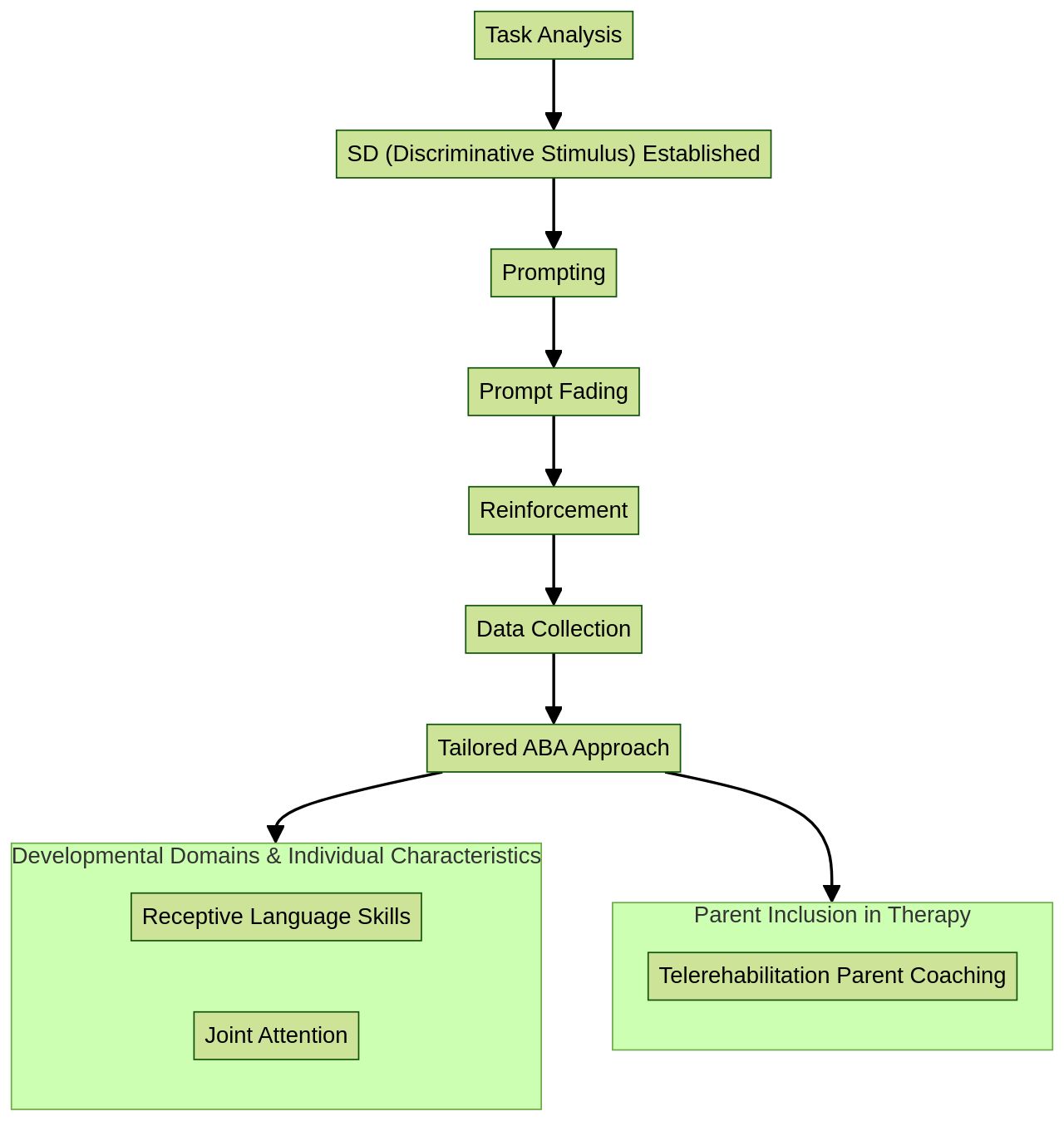
The art of tailoring Applied Behavior Analysis (ABA) to each child's needs is intricate but essential. Task Analysis breaks down complex activities into manageable steps, allowing for individualized learning pathways.
Establishing the SD, or discriminative stimulus, sets clear expectations for the child, signaling when a specific response is required. Prompting guides the child towards the correct response, with Prompt Fading gradually transferring control to them, fostering independence.
Reinforcement bolsters desirable behaviors, ensuring they are repeated, while Data Collection provides critical insights into the child's progress and the effectiveness of the interventions. This personalized approach is underscored by the findings of the MSEL and ELC scores, which reflect the nuanced progress children make across different developmental domains.
For instance, studies have shown that children who began with higher receptive language skills and engaged in joint attention responded more positively to interventions like JASPER, while those continuing with DTT demonstrated significant spoken language improvements over time. Moreover, the inclusion of parents in the therapy process, as evidenced by the success of telerehabilitation parent coaching, is imperative. Not only does it enhance the child's development, but it also positively impacts family dynamics and reduces parental stress. Embracing variability in practice, as research suggests, can lead to more robust skill acquisition and retention, further highlighting the importance of a tailored ABA approach. As one study's results indicate, maintaining and expanding on communication skills and compliance is possible with individualized treatments that take into account the child's specific needs and the natural environment in which they learn.
Individualizing Discrete Trial Training
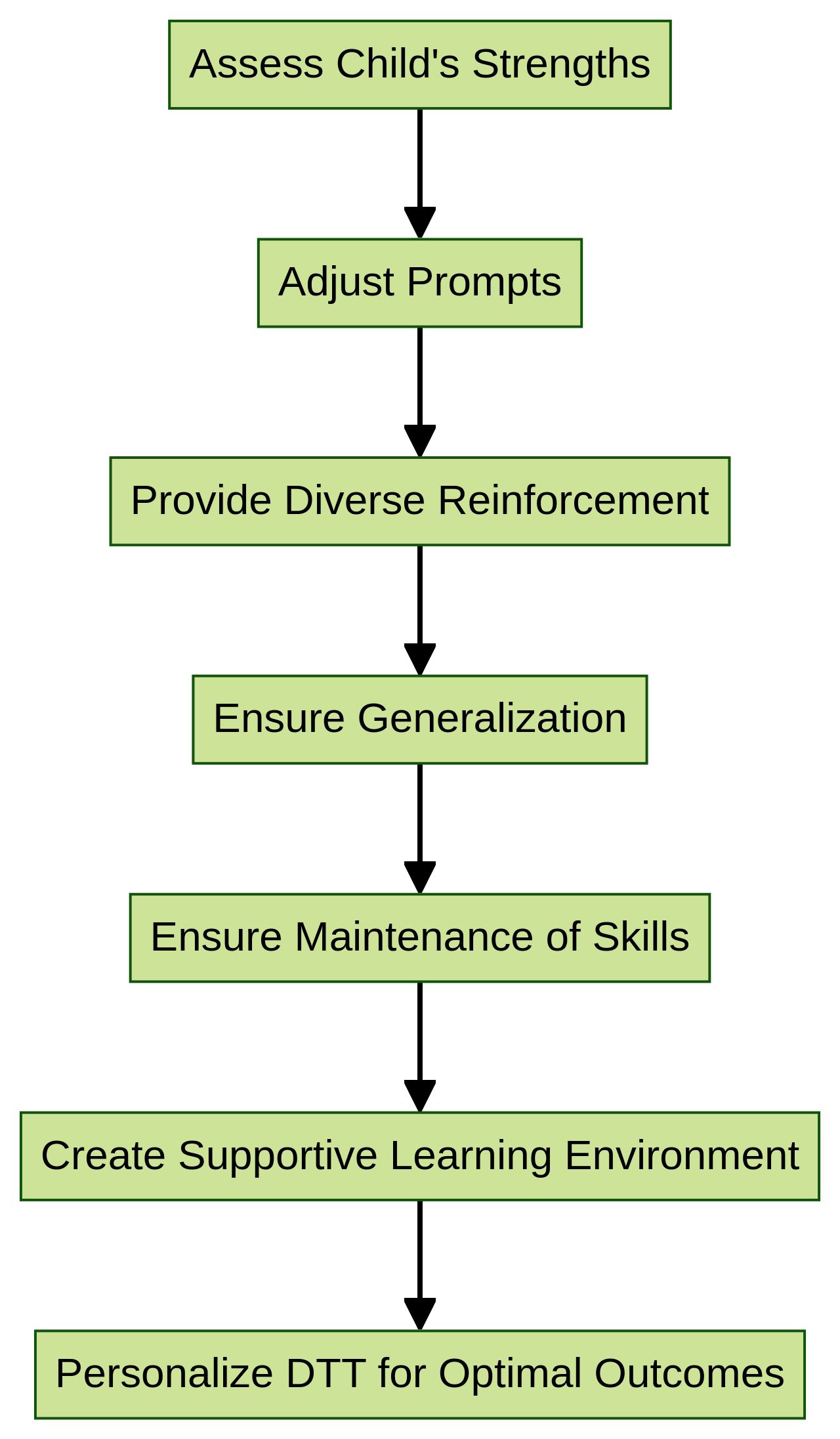
Tailoring Discrete Trial Training (DTT) to the unique needs of each child is essential for fostering their language and communication development. A study involving minimally verbal autistic preschoolers showed that, although children initially responded differently to various interventions, those who continued with DTT made more progress in spoken language.
This underscores the importance of personalizing DTT by evaluating a child's strengths and responding to their needs, adjusting prompts for optimal learning, and providing diverse reinforcement to sustain motivation. Additionally, ensuring that learned skills are generalized across settings and maintained over time is critical for long-lasting benefits.
For example, a single participant study demonstrated that breaking down treatment into functional communication, tolerance, and compliance components led to maintained and improved communication skills and compliance, even when faced with increased demands. It's vital to create a supportive learning environment that adapts to the child's changing needs and can be integrated into their daily life, such as in classroom settings, to promote the best outcomes. Each child's path to progress may look different, but with a customized approach to DTT, we can support their journey towards effective communication and integration.
The Importance of Parent Involvement
The active participation of parents in their child's developmental therapy, such as Discrete Trial Training (DTT), is not only beneficial but essential. By engaging in the process, parents can foster the generalization of learned behaviors to various settings, ensuring that their child can apply new skills beyond structured therapy sessions.
Consistent involvement allows for the reinforcement of these behaviors, creating a stable and supportive learning environment. Through close communication and collaboration with therapists, parents can become effective advocates for their child's unique needs, tailoring interventions to suit their individual profiles.
This personalization is crucial, as evidenced by studies showing that children with higher initial engagement levels make more substantial progress in interventions like JASPER, but those continuing with DTT post-treatment experience lasting improvements in spoken language. Parent training programs are particularly vital for mothers of children with ADHD, who are at higher risk for depression and elevated stress, providing them with strategies to manage attention deficits and enhance their child's functioning.
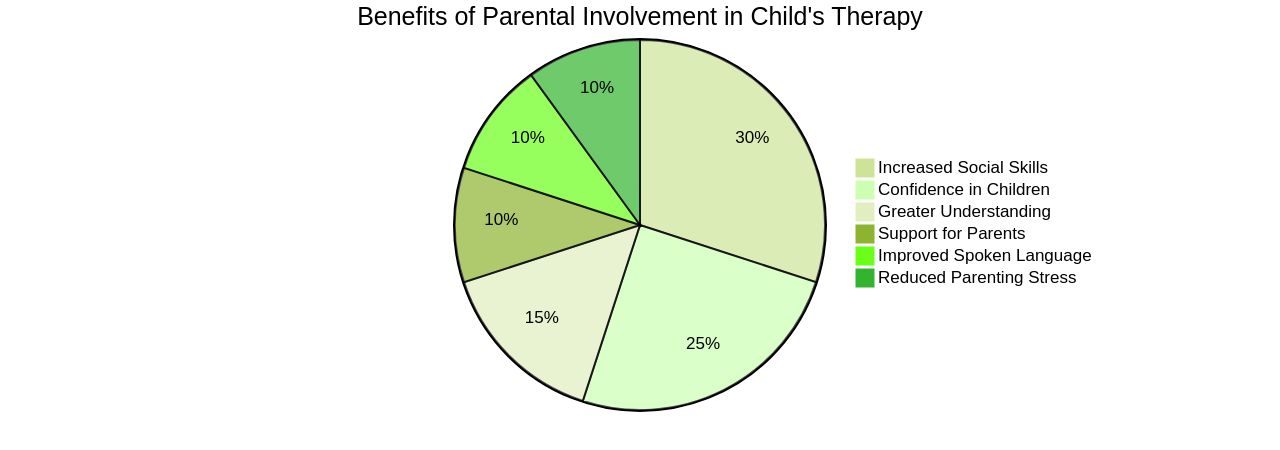
Moreover, parents report significant benefits from participating in programs like PEERS® for Preschoolers, noting increased social skills and confidence in their children and a greater understanding and support for themselves. The importance of adapting to each child's needs is highlighted by the shift towards neuro-affirming practices, which encourage interpreting behaviors as communication, especially in children with language delays. This approach is supported by studies which have found that specific coaching to increase verbalizations in children with language impairments can be highly effective. Thus, empowering parents through education and involvement in their child's therapy is key to reducing parenting stress and improving outcomes for the whole family.
Conclusion
In conclusion, Discrete Trial Training (DTT) is a highly effective and individualized approach for teaching children with autism. By breaking down complex behaviors into small, teachable units, DTT allows for tailored therapy that addresses each child's unique needs.
This personalized approach is crucial for maximizing outcomes and ensuring the well-being of children with autism. Implementing DTT involves task analysis, clear expectations, prompting fading, reinforcement, and data collection.
It is important to involve parents in the therapy process as they can reinforce learned behaviors and advocate for their child's needs. By evaluating a child's strengths, adjusting prompts and reinforcement, and promoting generalization across settings, we can support their journey towards effective communication and integration.
Parent involvement is vital in DTT as it not only benefits the child's development but also improves family dynamics. Empowering parents through education and involvement enhances outcomes for the entire family. By tailoring therapy to each child's unique needs and involving parents as advocates, we can ensure the well-being of children with autism and promote their success in communication and integration. In summary, DTT offers a structured approach that simplifies learning for children with autism by breaking down behaviors into manageable units. By individualizing therapy and involving parents, we can maximize outcomes and support the overall well-being of children with autism.
Frequently Asked Questions
What is Discrete Trial Training (DTT)?
Discrete Trial Training (DTT) is a structured method of teaching that breaks down complex behaviors into small, teachable units. It's a component of Applied Behavior Analysis (ABA) and is particularly effective for children with autism in individualized settings.
Why is DTT effective for children with autism?
DTT is effective because it simplifies learning by focusing on specific challenges that children with autism face. It can be tailored to address functional communication, compliance with instructions, and other key skills, leading to significant improvements in behavior.
Can DTT skills be generalized to other environments?
Yes, one of the strengths of DTT is the ability to generalize learned skills to other environments such as home and school, making it a versatile approach for children with autism.
Why is it important to customize therapy for each child?
Customizing therapy is crucial because a one-size-fits-all approach does not cater to the diverse needs of children with autism. Individualized treatment plans take into account each child's baseline abilities and desired outcomes to improve their quality of life.
What are the key components of Discrete Trial Training?
The key elements of DTT include: Discriminative Stimulus (SD), Response, Reinforcement, and Prompting. Customizing these elements to the child's needs is essential.
How does the initial ability of a child impact the success of DTT?
Studies have shown that children with higher receptive language skills and joint attention at the beginning of an intervention tend to make more progress, which highlights the importance of tailoring interventions to each child's initial abilities.
What should be considered when determining the duration and intensity of ABA therapy?
When deciding on treatment duration and intensity, individual factors such as the child's baseline skills and goals for life improvement should be considered. This helps ensure a healthy therapy-life balance for the child and family.
What is the role of variability in practice design for ABA therapy?
Incorporating variability in practice design can benefit skill acquisition and memory formation, leading to better retention and transfer of skills to new tasks.
How is DTT implemented?
DTT is implemented through steps that include task analysis, establishing clear expectations, prompting, prompt fading, reinforcement, and data collection to track progress. It involves a personalized approach to suit each child's learning needs.
How can parents be involved in DTT, and why is it important?
Parents can participate in therapy by reinforcing behaviors, being advocates for their child's needs, and collaborating with therapists. Parental involvement is essential for generalizing behaviors to different settings and for reducing parental stress.
What is the impact of individualized DTT on language and communication development?
Tailoring DTT to the child's unique needs can significantly foster their language and communication development. Studies have shown that children who continue with personalized DTT make progress in spoken language.
Can DTT be adapted to the changing needs of a child?
Yes, it's vital to create a supportive learning environment that adapts to the child's evolving needs and can be integrated into their daily life to promote the best outcomes.
What is neuro-affirming practice, and how does it relate to DTT?
Neuro-affirming practice encourages interpreting behaviors as communication, which is particularly important for children with language delays. It aligns with the principles of DTT by emphasizing the importance of understanding and responding to the individual needs of children with autism.
List of Sources
- Understanding Discrete Trial Training (DTT)
- pubmed.ncbi.nlm.nih.gov (https://pubmed.ncbi.nlm.nih.gov/37332371)
- hitconsultant.net (https://hitconsultant.net/2023/09/12/applied-behavior-analysis-aba-why-more-is-not-always-better/)
- journals.sagepub.com (https://journals.sagepub.com/doi/10.1177/014544557714001)
- onlinelibrary.wiley.com (https://onlinelibrary.wiley.com/doi/10.1002/bin.1989)
- mdpi.com (https://www.mdpi.com/2076-328X/13/6/484)
- onlinelibrary.wiley.com (https://onlinelibrary.wiley.com/doi/10.1002/bin.1989)
- Key Components of Discrete Trial Training
- frontiersin.org (https://www.frontiersin.org/articles/10.3389/fpsyt.2023.1205532/pdf)
- storage.googleapis.com (https://storage.googleapis.com/jnl-up-j-jc-files/journals/1/articles/314/64e722eb56de9.pdf)
- pubmed.ncbi.nlm.nih.gov (https://pubmed.ncbi.nlm.nih.gov/37332371)
- journals.lww.com (https://journals.lww.com/jrnldbp/abstract/2006/04002/early_intensive_behavioral_treatment__replication.13.aspx)
- hitconsultant.net (https://hitconsultant.net/2023/09/12/applied-behavior-analysis-aba-why-more-is-not-always-better/)
- link.springer.com (https://link.springer.com/article/10.1007/s40614-023-00380-3)
- basketballimmersion.com (https://basketballimmersion.com/basketball-decision-training-2-0-adding-more-variability/)
- spectrumnews.org (https://www.spectrumnews.org/news/two-scientists-two-interventions-a-gentle-rivalry-to-aid-autistic-children/)
- ies.ed.gov (https://ies.ed.gov/blogs/research/post/early-intervention-and-beyond-how-experience-with-young-children-and-special-education-motivated-a-career-in-autism-research)
- pubs.asha.org (https://pubs.asha.org/doi/full/10.1044/2023_PERSP-23-00104)
- Steps in Implementing Discrete Trial Training
- onlinelibrary.wiley.com (https://onlinelibrary.wiley.com/doi/10.1002/bin.1989)
- link.springer.com (https://link.springer.com/article/10.1007/s40614-023-00380-3)
- pubmed.ncbi.nlm.nih.gov (https://pubmed.ncbi.nlm.nih.gov/37332371)
- trialsjournal.biomedcentral.com (https://trialsjournal.biomedcentral.com/counter/pdf/10.1186/s13063-023-07488-6)
- spectrumnews.org (https://www.spectrumnews.org/news/two-scientists-two-interventions-a-gentle-rivalry-to-aid-autistic-children/)
- hitconsultant.net (https://hitconsultant.net/2023/09/12/applied-behavior-analysis-aba-why-more-is-not-always-better/)
- link.springer.com (https://link.springer.com/content/pdf/10.1007/s40614-023-00380-3.pdf)
- basketballimmersion.com (https://basketballimmersion.com/basketball-decision-training-2-0-adding-more-variability/)
- towardsdatascience.com (https://towardsdatascience.com/reinforcement-learning-introduction-and-main-concepts-48ea997c850c)
- journals.sagepub.com (https://journals.sagepub.com/doi/10.1177/002246698001400304)
- onlinelibrary.wiley.com (https://onlinelibrary.wiley.com/doi/10.1002/bin.1989)
- dovepress.com (https://www.dovepress.com/getfile.php)
- Individualizing Discrete Trial Training
- spectrumnews.org (https://www.spectrumnews.org/news/two-scientists-two-interventions-a-gentle-rivalry-to-aid-autistic-children/)
- pubmed.ncbi.nlm.nih.gov (https://pubmed.ncbi.nlm.nih.gov/37332371)
- onlinelibrary.wiley.com (https://onlinelibrary.wiley.com/doi/10.1002/bin.1989)
- hitconsultant.net (https://hitconsultant.net/2023/09/12/applied-behavior-analysis-aba-why-more-is-not-always-better/)
- frontiersin.org (https://www.frontiersin.org/journals/psychology/articles/10.3389/fpsyg.2024.1291198/full)
- journals.lww.com (https://journals.lww.com/jrnldbp/abstract/2006/04002/early_intensive_behavioral_treatment__replication.13.aspx)
- nature.com (https://www.nature.com/articles/s41398-023-02547-7)
- onlinelibrary.wiley.com (https://onlinelibrary.wiley.com/doi/full/10.1002/cl2.1368)
- onlinelibrary.wiley.com (https://onlinelibrary.wiley.com/doi/full/10.1111/1460-6984.12990)
- The Importance of Parent Involvement
- pubmed.ncbi.nlm.nih.gov (https://pubmed.ncbi.nlm.nih.gov/37332371)
- kidney.org (https://www.kidney.org/newsletter/baby-dialysis-family-s-brave-battle-and-journey-to-transplant)
- mdpi.com (https://www.mdpi.com/1660-4601/20/14/6334/pdf)
- onlinelibrary.wiley.com (https://onlinelibrary.wiley.com/doi/10.1111/jmft.12648)
- mdpi.com (https://www.mdpi.com/2076-328X/13/8/691/pdf)
- spectrumnews.org (https://www.spectrumnews.org/news/two-scientists-two-interventions-a-gentle-rivalry-to-aid-autistic-children/)
- dovepress.com (https://www.dovepress.com/getfile.php)
- additudemag.com (https://www.additudemag.com/parenting-styles-authoritative-neurodivergence/)
- psychologicalscience.org (https://www.psychologicalscience.org/news/utc-2024-apr-parental-engagement.html)
- journals.sagepub.com (https://journals.sagepub.com/doi/pdf/10.1177/13623613231172314)
- theatlantic.com (https://www.theatlantic.com/ideas/archive/2023/11/teen-mental-health-dbt/675895/)
- chicagoparent.com (https://www.chicagoparent.com/education/early-education/child-care-benefits/)
- journals.sagepub.com (https://journals.sagepub.com/doi/pdf/10.1177/13623613231172314)


